
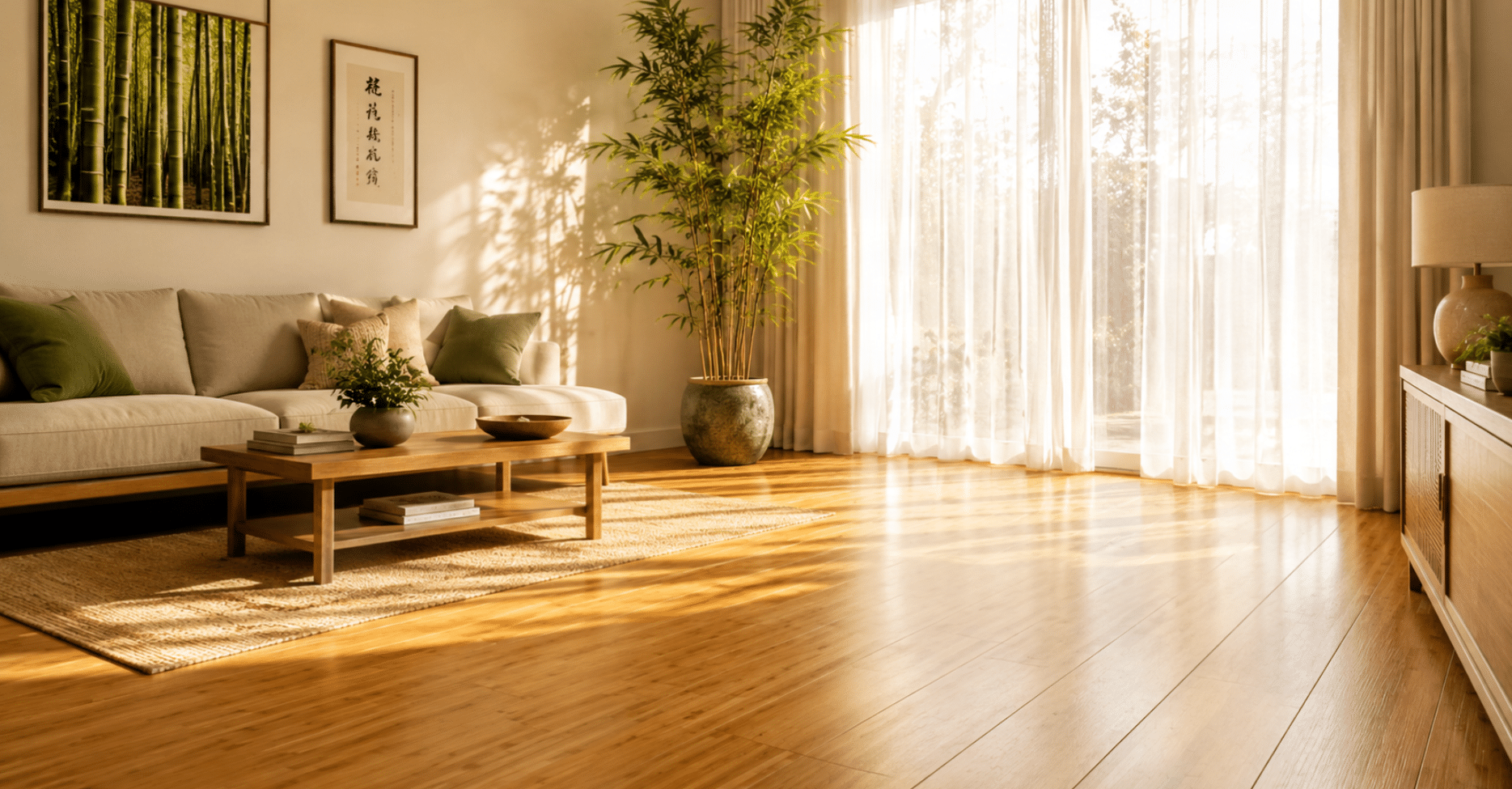
Yes, bamboo flooring can be eco-friendly, but only if you choose it carefully. You should look for FSC-certified products, responsible harvesting, and low-VOC adhesives and finishes. Bamboo regrows fast, yet manufacturing can be energy-intensive and some cheaper floors off-gas formaldehyde. Strand-woven bamboo can be very durable, but transport and chemical processing still matter. If you want the full picture, there’s a lot more to compare before you buy.
Quick Overview
- Bamboo flooring can be eco-friendly because bamboo regrows quickly and stores carbon, but sustainability depends on responsible sourcing.
- Certifications like FSC help verify low-impact harvesting, reduced chemical use, and better environmental practices.
- Manufacturing can be energy-intensive and use adhesives that release formaldehyde, so low-VOC products are preferable.
- Strand-woven bamboo is durable, but shipping from overseas can increase its overall carbon footprint.
- To choose greener bamboo flooring, look for mature hand-harvested bamboo, transparent sourcing, and low-emission finishes.
Is Bamboo Flooring Really Eco-Friendly?
Yes, bamboo flooring can be really eco-friendly, but only when you look beyond the label. You should weigh bamboo sustainability against sourcing, transport, and manufacturing choices.
Bamboo grows back quickly, stores carbon, and can produce more oxygen than hardwood forests, so bamboo flooring eco friendly claims can be valid. Still, you need to check bamboo floor certifications, since responsible harvesting and low-chemical processing matter.
Choose FSC-certified products when you can, and look for responsible harvesting practices rather than relying only on the material name. If you compare lifecycle impacts carefully, you’ll see bamboo can be a smart choice, but it isn’t automatically the greenest option.
Why Bamboo Grows Back So Fast
You can see bamboo grow back so quickly because its rhizome root system stays intact after harvest and sends up new shoots fast. New groves are often managed to avoid soil disruption by allowing the rhizomes to keep regenerating after harvest. Unlike trees, it reaches maturity in just 4 to 5 years, so you don’t wait decades for a usable crop. Since you can harvest the stems without replanting, bamboo keeps regenerating with less disruption to the soil. Fast growth also makes bamboo a more sustainable choice than many traditional materials.
Rapid Root Regeneration
Bamboo rebounds fast because its underground rhizome system keeps working after harvest. You keep the roots intact during selective cutting, so the plant quickly pushes out new shoots from stored energy and nutrients.
That’s why bamboo renewable growth supports bamboo floor environmental claims and helps green bamboo flooring stay appealing. Within weeks, fresh culms can appear, and some shoots surge upward at striking speed.
You don’t need to replant, irrigate, or add chemicals for regrowth. The dense root network also holds soil in place, limits erosion, and keeps the grove stable while regeneration continues naturally.
Fast Maturity Cycle
That quick rebound comes from bamboo’s unusually fast maturity cycle. You see harvestable stems in about 4 to 5 years, while hardwoods may need 20 to 60 years. Some bamboo shoots even hit full size in under four months, and certain species can grow 2 feet, or more, in a day. That speed lets plantations keep producing without long waits, so the plant keeps drawing in carbon during each growth burst.
When you choose bamboo flooring, formaldehyde concerns still matter, but bamboo’s rapid cycle can help lower the overall environmental burden compared with slow-growing timber. Bamboo is a grass, not a tree, which helps explain why it grows back so quickly. Bamboo plants also regenerate from new shoots after harvesting, rather than requiring years-long replanting like many slow-growing timber stands.
Harvest Without Replanting
Because bamboo is harvested by cutting the culms above ground, the underground rhizome network stays intact and sends up new shoots without replanting. You get repeated harvests from the same root stock, sometimes for decades. This makes bamboo farming especially sustainable because the plant can regenerate after each harvest.
Hand cutting protects the roots, soil, and nearby wildlife, while staggered harvesting keeps supply steady.
- Roots stay alive
- New shoots emerge naturally
- No seed planting is needed
- Soil erosion stays low
- One grove yields many crops
How Bamboo Harvesting Affects Forests
When bamboo is harvested responsibly, it can support forests rather than strip them: workers often cut mature stalks by hand, sections are taken on a rotating schedule, and the same stock can regrow without replanting thanks to bamboo’s fast recovery.
You’ll see FSC certification color-coded stands cut only after about five years, which helps preserve the forest’s rhythm.
But if growers clear natural forests for plantations, they can disrupt ecosystems, deplete soil, and crowd out wildlife.
Demand can push monoculture expansion, yet careful harvesting still lets you use land repeatedly while avoiding complete depletion and supporting local jobs in developing countries.
Why FSC-Certified Bamboo Flooring Matters
When you choose FSC-certified bamboo flooring, you’re choosing wood that comes from responsibly managed forests and meets strict environmental and social standards.
FSC chain-of-custody certification tracks the material from the farmer to the seller, so you know the product really is what it claims to be. That verification helps you trust that the bamboo was harvested sustainably, not just labeled eco-friendly.
FSC certification also helps ensure the bamboo is sourced from responsibly managed forests, supporting biodiversity, indigenous rights, and community well-being.
FSC Chain Of Custody
- Certified forest management
- Audited growers and manufacturers
- Tracked production stages
- Verified origin and handling
- Clear FSC labeling
When you choose FSC-certified flooring, you support responsible sourcing, biodiversity, and community well-being without relying on vague green claims. FSC-certified bamboo flooring also helps ensure the material comes from responsibly managed forests.
Verified Sustainable Harvesting
That means mature bamboo culms get selectively cut, often by hand, after four to five years, while groves keep regenerating without clear-cutting. FSC certification also helps you identify products from well-managed plantations, including some in China. Monoculture farming can still reduce biodiversity and deplete soil nutrients if plantations are not managed carefully.
Responsible Forest Management
FSC-certified bamboo flooring matters because the Forest Stewardship Council is an independent nonprofit that verifies responsible forest management from grove to finished product.
When you choose it, you support:
- biodiversity protection
- indigenous rights
- community well-being
- sustainable harvesting plans
- supply-chain accountability
FSC checks farmers, manufacturers, and sellers, so you’re not guessing about origin or methods.
It also confirms bamboo, though it’s grass, comes from managed forests where mature stalks are cut on a five-year cycle. That helps preserve ecosystem balance, carbon storage, and local livelihoods.
Noncertified bamboo can vary widely, so FSC gives you real sustainability, not just fast regrowth. Bamboo options vary widely, so careful certification can help buyers compare products that differ in adhesives, emissions, and sourcing.
What Happens During Bamboo Manufacturing?
Bamboo manufacturing starts with cutting mature stalks at the base so the plant can regrow naturally. Then the stalks are sliced into strips, laminated with glue, and milled into flooring profiles.
You’ll also see energy-hungry machinery, often powered by coal-heavy electricity, driving each stage. In some facilities, waste piles up and can end up in landfills.
Quality matters too: reputable makers follow stricter standards, while cheaper products may cut corners. When you buy strand-woven boards or FSC-certified flooring, you’re choosing a process that can be more durable and better managed.
How Bamboo Flooring Can Release Formaldehyde
You’ll usually find that bamboo flooring releases formaldehyde from the glues that hold the strips together, especially when manufacturers use urea-formaldehyde or phenol-formaldehyde resins.
Cheaper products can also off-gas from formaldehyde-containing finishes, which adds to indoor air pollution.
If you want lower emissions, you should check the adhesive and finish type before you buy.
Glue-Bonded Off-Gassing
Even though bamboo is a fast-growing, renewable material, the flooring can still off-gas formaldehyde when manufacturers use glue-based binders and adhesives.
When you choose bamboo, check the binder type and emission rating.
- Phenol-formaldehyde resins can emit 0.2–0.3 ppm.
- Premium products often stay below 0.05 ppm.
- Urea-formaldehyde glues can release significant formaldehyde.
- CARB Phase 2 sets the strictest U.S. limit.
- Low-emission floors can meet E1, E0, and Floorscore targets.
Cheap glue-bonded planks may also lose durability.
If you want healthier indoor air, buy certified bamboo with eco-friendly adhesives and transparent testing data.
Emissions From Finishes
Beyond the glue and core layers, the finish on bamboo flooring can also release formaldehyde into your home.
If you choose premium products, you’ll usually stay below 0.05 ppm, which meets CARB Phase 2 and often E1 or E0 standards. Cheaper finishes can emit 0.2 to 0.3 ppm, and those levels can hurt your indoor air quality.
Look for Floorscore certification and low-emission labels, because they help you avoid urea-formaldehyde coatings and other VOCs.
Even bamboo itself can off-gas a little during processing, so better finishes matter when you want a healthier floor.
Strand-Woven Bamboo: Strength and Tradeoffs
Strand-woven bamboo is one of the toughest flooring options out there, with a Janka rating over 3,000—more than twice as hard as oak—because bamboo fibers are compressed under extreme pressure and bound with resin into dense, durable planks.
You get exceptional toughness, but you should still weigh tradeoffs.
- Great for kids and pets
- Stays stable in busy rooms
- Resists wear better than hardwood
- Can scratch or dent
- Isn’t best for damp spaces
Because it’s made from fast-renewing bamboo grass, not trees, you can see why it feels eco-friendlier.
Yet quality varies, so choose carefully.
How Bamboo Flooring Gets Shipped
When you look at bamboo flooring, you’ll usually find it shipped from China to the U.S. or Europe in ocean freight containers.
Those ships can carry huge loads efficiently, but they still burn diesel and create emissions along the way.
Ocean Freight Efficiency
Because most bamboo flooring is made near China’s coastal factories, it can move straight into massive container ships and cross the ocean in huge batches.
You benefit from ocean freight’s scale: ships can hold up to 20,000 containers, so each trip spreads transport across far more flooring than trucks can.
- Huge cargo holds cut extra voyages
- Coastal factories reduce inland hauling
- One ship replaces many truckloads
- Bulk shipping keeps logistics efficient
- Port-to-port routes stay direct
That density helps lower transport per unit, and you’re comparing it with trucking, which burns more fuel for less cargo.
Shipping Emissions Tradeoffs
Even so, bamboo flooring’s shipping story has tradeoffs you should weigh. You usually get it from coastal factories in China, where growers and mills sit close together, so trucks burn less fuel before loading.
Then one ocean voyage can beat the long, multi-leg trips that hardwood often takes. Still, container ships burn dirty diesel at sea, and that adds pollution. Their huge capacity cuts emissions per box, but shipping still matters.
Some sellers buy offsets, yet those won’t stop fuel use. If you can source regional hardwood, you may cut transport emissions even more.
Bamboo Flooring vs Hardwood Carbon Footprint
Bamboo often looks greener than hardwood at first glance, since it regenerates in just 3–7 years while hardwood trees can take 40–70 years to mature.
You’ll also notice bamboo can sequester carbon quickly, but its footprint doesn’t stop there.
- Bamboo grows fast and renews rapidly.
- It stores carbon during growth.
- Manufacturing uses more energy and resins.
- Shipping from China adds emissions.
- Hardwood may need more time, but it can last far longer.
When you compare total lifecycle emissions, bamboo’s raw-material advantage can shrink.
Hardwood’s slower renewal doesn’t automatically make it worse; transport, processing, and longevity all matter.
When Bamboo Flooring Is the Greener Choice
That doesn’t mean bamboo flooring never makes sense; in the right situation, it can be the greener pick.
You may choose it when you want a rapidly renewable material that matures in 3 to 7 years, not decades. Because bamboo regenerates from intact roots, you don’t need to replant after selective harvesting. Responsible producers also cut by hand, helping preserve forests.
If you buy FSC-certified bamboo, you support verified stewardship. Bamboo’s fast regrowth can boost oxygen output and carbon sequestration.
Plus, you can refinish some floors, extending their life and reducing replacements.
Where Bamboo Flooring Falls Short
Despite its fast growth, bamboo flooring has real drawbacks that can undercut its eco-friendly image. You still face:
- Long-distance shipping from Asia that burns fuel and raises carbon emissions
- Fertilizer-heavy farming, pesticide use, and clear-cutting that strain ecosystems
- Energy-intensive manufacturing, plus formaldehyde-emitting finishes in cheaper products
- Questionable durability, which can mean earlier replacement and landfill waste
- Labor and land-use concerns where production can displace food crops and rely on poor conditions
How to Spot Sustainable Bamboo Flooring
To tell whether you’re buying truly sustainable bamboo flooring, you need to look past marketing claims and check for proof.
You should ask for recognized eco-certifications and third-party verification, since they show responsible harvesting, forest regeneration, and safer manufacturing.
Check that the supplier provides sustainability documents.
Make sure the bamboo was harvested after about five years of maturity, not stripped all at once.
Choose products made with low-toxicity adhesives and finishes, not formaldehyde-heavy coatings.
If the maker uses careful forest management and transparent production standards, you’re far more likely to get genuinely sustainable flooring.
Bamboo Flooring vs North American Hardwood
When you compare bamboo flooring with North American hardwood, bamboo usually wins on renewability because it can regrow in 3 to 7 years, while hardwood trees often need 40 to 70 years to mature.
You’ll also see bamboo rebound without replanting, but hardwood must be felled and replanted.
Still, hardwood can travel less and often uses less energy to process.
- Bamboo grows fast.
- Hardwood matures slowly.
- Bamboo stores carbon.
- Hardwood ships locally.
- FSC helps both.
Choose bamboo for rapid regrowth; choose hardwood for lower transport if you source it nearby.
Cleaner Bamboo Flooring Brands to Look For
If you’re shopping for cleaner bamboo flooring, look for brands that spell out their sourcing, manufacturing, and finish standards.
You’ll want clear details on harvest age, drying methods, Janka hardness, VOC levels, and adhesives, because those specs tell you a lot about quality and indoor air friendliness.
Brands that use mature, hand-harvested bamboo, rotate forest sections, and support local or efficient manufacturing can lower impacts.
You can also favor makers that highlight renewable bamboo’s fast regrowth, strong durability, and easy cleaning with pH-neutral products.
Transparent brands make greener choices easier.
Signs a Bamboo Floor Is Not Eco-Friendly
Signs a bamboo floor isn’t eco-friendly when the product depends on clear-cut harvesting, heavy fertilizer or pesticide use, or even the replacement of food crops and forests to make room for bamboo farms.
You should also watch for these red flags:
- heavy chemical finishes
- high shipping emissions
- energy-intensive manufacturing
- formaldehyde or VOC off-gassing
- poor durability and fast replacement
If you see bamboo sourced from cleared forests or made with strong adhesives, it can harm soil, water, and indoor air.
Low-grade flooring may end up in landfills sooner, undercutting any green claims.
Is Bamboo Flooring Worth Buying?
Bamboo flooring can be worth buying if you choose a well-made, responsibly sourced product. You get a renewable material that matures in just 3-7 years, rebounds after harvest, and can store carbon while it grows.
Strand-woven options can outperform many hardwoods, resisting dents and scratches with impressive strength. You can also save money with price-competitive, long-lasting floors that need little upkeep.
Pick FSC-certified bamboo, and you support responsible forestry, avoid harmful pesticides, and reduce deforestation. It also brings a natural look that fits many rooms and styles.
Frequently Asked Questions
Does Bamboo Flooring Require Replanting After Harvest?
No, you usually don’t replant bamboo flooring stock after harvest; bamboo regenerates from intact roots. You’ll cut culms above the root system, and the same plant can regrow and be harvested again and again.
How Long Does Bamboo Take to Mature for Flooring?
You’ll usually wait 3 to 5 years for bamboo to mature, but flooring-grade stalks reach peak strength in about 5 to 7 years. That’s much faster than hardwoods, which can take decades.
Why Can Bamboo Flooring Still Contain Formaldehyde?
You can still find formaldehyde in bamboo flooring because you’re buying glued strips, engineered cores, and finishes that often use resin binders. Even premium products may trace VOCs, so you should check certifications and emissions data.
Does Shipping Bamboo From China Reduce Its Eco-Benefits?
Yes, you’ll reduce some benefits, because ocean shipping still burns fuel. But you may still come out ahead versus hardwood with longer, multi-leg transport, especially when bamboo’s production stays close to China’s coast.
What Makes FSC Certification Important for Bamboo Flooring?
FSC certification shows you’re choosing bamboo that’s responsibly grown, harvested, and processed. It protects forests, biodiversity, workers, and communities, verifies the supply chain, and helps you avoid misleading claims about sustainability in flooring.
Conclusion
So, is bamboo flooring really eco-friendly? It can be, but only if you choose it carefully. You’ll want to look for FSC certification, low-VOC finishes, and brands that are transparent about sourcing and manufacturing. Bamboo grows fast, but that doesn’t automatically make every product green. If you compare options and avoid cheap, poorly made floors, you can make a smarter, more sustainable choice for your home and the planet too.