
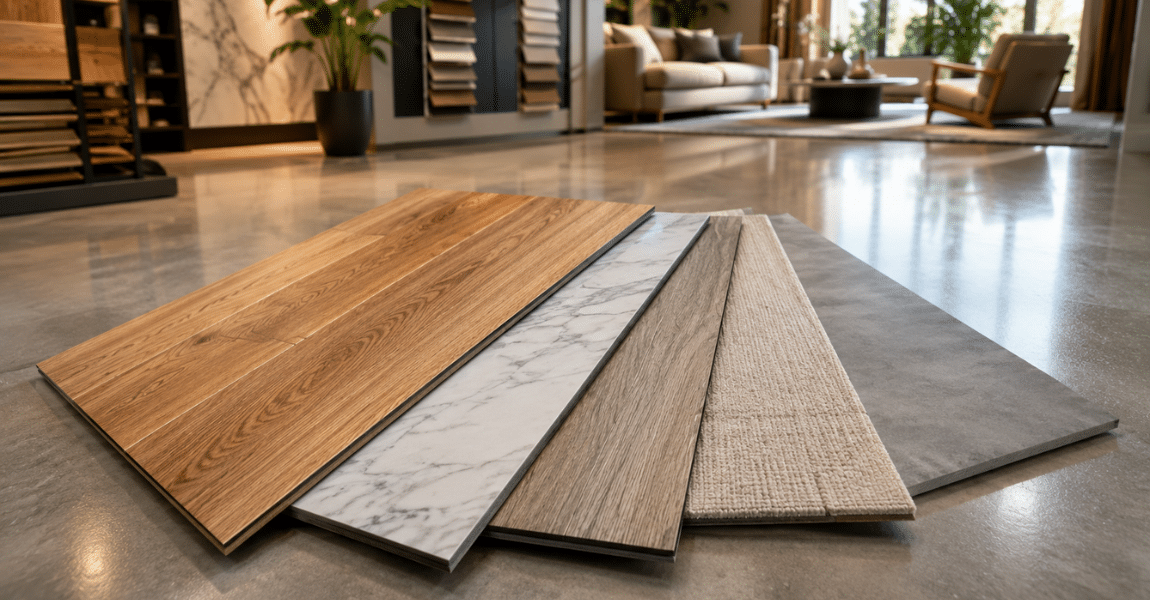
There is no single “best flooring” for a house – there’s a best flooring for each room. A floor that’s perfect in a bedroom will fail in a bathroom, and a floor that thrives in a mudroom would feel cold and clinical in a living room. After 25+ years installing floors, the mistake I see most often is picking one material for the whole house to keep it simple, then watching it fail in the rooms that needed something different.
This guide fixes that. Below is the right flooring for every room in your home, grouped by the demands each space actually places on a floor — moisture, traffic, comfort, and budget. Use the quick-reference table to scan, then jump into the full guide for any room you’re tackling.
How to choose flooring room by room: the 4 factors
Every room is really just a different mix of four demands. Get these right and the material choice almost makes itself.
- Moisture. Wet and utility rooms (kitchen, bathroom, basement, laundry, mudroom) need waterproof, not “water-resistant,” materials. This single factor rules out wood in half your house.
- Traffic & wear. Entryways, kitchens, living rooms, and stairs take heavy footfall and grit; they need hard-wearing, scratch-resistant surfaces.
- Comfort & warmth. Bedrooms and living rooms are where you stand, sit, and walk barefoot — warmth and softness matter more than maximum durability.
- Budget. Material and installation. Tile costs more to install than vinyl; wood costs more than laminate. We give real ranges for each room below.
When two factors conflict — a basement that you want to feel cozy but must stay dry — moisture always wins. You can warm up a waterproof floor with rugs or radiant heat; you can’t make a comfortable-but-porous floor survive a flood.
Best flooring by room: quick reference
| Room | Top pick | Strong runner-up | Avoid | Typical installed cost (per sq ft) |
|---|---|---|---|---|
| Kitchen | Luxury vinyl (LVP) | Porcelain tile | Solid hardwood, carpet | $3–$20 |
| Bathroom | Porcelain tile | Waterproof LVP | Hardwood, standard laminate | $2–$20 |
| Basement | Rigid-core LVP | Tile / epoxy | Solid hardwood, standard laminate | $3–$18 |
| Laundry room | Porcelain tile | SPC vinyl | Wood, laminate, carpet | $2–$18 |
| Mudroom / entryway | Porcelain tile | LVP | Hardwood, carpet | $3–$25 |
| Sunroom | Porcelain tile | Waterproof vinyl | Solid hardwood (UV fade), laminate | $2–$18 |
| Living room | Hardwood / engineered | Luxury vinyl | (Guide by lifestyle/budget) | $4–$15 |
| Bedroom | Carpet or hardwood | Luxury vinyl | Cold/hard floors without rugs | $2–$12 |
| Home office | Luxury vinyl (chair-friendly) | Hardwood / laminate | Deep-pile carpet (no chair mat) | $3–$12 |
| Stairs | Carpet (safety) or hardwood + runner | Luxury vinyl | Slippery bare surfaces | Varies |
| Garage | Epoxy / polyaspartic coating | Polished concrete, tiles | Anything not vehicle-rated | $3–$12 |
| Home gym | Rubber | Foam / vinyl tiles | Hard surfaces for free weights | $3–$8 |
Wet & utility rooms (the “must be waterproof” group)
These five rooms share one rule: waterproof or don’t bother. Tile and waterproof vinyl dominate here for good reason.
- Kitchen — Luxury vinyl plank is my default for most kitchens (waterproof, warm, easy); porcelain tile is the forever option. Skip solid hardwood and carpet. → Read the full guide: best flooring for kitchens.
- Bathroom — Porcelain tile is the standard; waterproof LVP is the warmer, cheaper alternative. Choose textured/matte finishes for slip safety, and never use real wood. → Read the full guide: best flooring for bathrooms.
- Basement — Rigid-core (SPC) vinyl for living spaces, tile or epoxy for maximum moisture immunity. Moisture-test the slab before you install anything. → Read the full guide: best flooring for basements.
- Laundry room — Porcelain tile or SPC vinyl; both handle leaks and appliance weight. Assume the washer will leak someday and choose 100% waterproof. → Read the full guide: best flooring for laundry rooms.
- Mudroom & entryway — Porcelain tile or LVP to handle wet boots, mud, and grit. Sealed concrete and slate are excellent for tougher or more upscale looks. → Read the full guide: best flooring for mudrooms & entryways.
- Sunroom — Tile and waterproof vinyl handle the moisture and the UV; avoid solid hardwood (it fades and warps in direct sun) and laminate. → Read the full guide: best flooring for sunrooms.
Living & comfort rooms (where warmth and feel matter)
Here the demands flip: comfort, warmth, and looks lead, with moisture a minor concern.
- Living room — Hardwood and engineered wood for warmth and resale value; luxury vinyl for a durable, budget-friendly look that handles family life. → Read the full guide: best flooring for living rooms.
- Bedroom — Carpet for cozy warmth, or hardwood for a timeless, allergy-friendlier surface (add rugs for softness). Low traffic means durability matters least here. → Read the full guide: best flooring for bedrooms.
- Home office — Luxury vinyl is the smart pick because it stands up to rolling chairs; pair any hard floor with a chair mat, or use low-pile carpet for sound control. → Read the full guide: best flooring for home offices.
- Stairs — Safety first: carpet gives the best grip and noise control, while hardwood with a runner balances looks and safety. Avoid slippery bare-hard surfaces. → Read the full guide: best flooring for stairs.
Specialty & hard-use rooms
These spaces have specialized needs and their own material worlds.
- Garage — Epoxy or polyaspartic coatings and polished concrete handle vehicle weight, hot-tire pickup, and chemicals. → Read the full guide: best flooring for garages.
- Home gym — Rubber flooring (3/8″–3/4″ thick) absorbs impact, protects the subfloor, and dampens noise; foam tiles work for lighter, floor-based workouts. → Read the full guide: best flooring for home gyms.
Whole-home flooring flow: making rooms work together
One of the most common questions I get is whether every room should match. The answer: flow, doesn’t necessarily match. A few principles that work in real homes:
- Run one floor through connected open spaces. Carry the same wood-look LVP or hardwood through the entry, kitchen, and living area for a seamless, larger feel.
- Change materials at doorways, not mid-room. Transitions belong where a wall or threshold naturally divides spaces — between the tiled bathroom and the hardwood hallway, for example.
- Keep a consistent tone. Even when materials change (tile in the bath, wood in the bedroom), matching the color temperature keeps the home feeling cohesive.
- Let wet rooms be different. Nobody expects the bathroom or laundry to match the living room. Choose the right waterproof floor there and use transition strips to bridge the change.
Good transitions are an installation detail worth getting right — see our flooring installation guides for how to handle thresholds and height differences between materials.
What does flooring cost across a whole home?
As a rough 2026 guide (materials + installation), most residential flooring ranges from $2 to $20 per square foot installed, depending on the material and room. The cheapest paths are vinyl sheet and laminate ($2–$8); the mid-range is LVP and engineered wood ($4–$15); the premium end is tile and natural stone ($7–$25+), mostly because of labor. For a whole-home project, the biggest swing factors are how much tile you choose (labor-heavy) and subfloor prep – leveling, moisture barriers, and removing old flooring. Always get itemized quotes so those prep costs aren’t a surprise. Full breakdown in the flooring cost guide.
How to budget and sequence a whole-home flooring project
Re-flooring a whole house at once is rarely the right move — financially or practically. The homeowners who get the best result (and the fewest regrets) treat it as a sequenced project, not a single purchase. Here’s the approach I walk clients through.
Step 1: Set a realistic whole-home budget
Start with rough math: your home’s square footage × a blended rate. Most whole-home projects land around $6–$12 per square foot installed once you mix cheaper bedrooms with pricier wet rooms. For a 2,000 sq ft home, that’s roughly $12,000–$24,000 — a wide range that’s driven almost entirely by three choices:
- How much tile. Tile’s material and labor are the biggest budget movers. Every room you switch from vinyl to tile adds meaningfully to the total.
- Subfloor condition. Leveling, moisture barriers, and removing old flooring can add $1–$4 per square foot, which is invisible until the old floor comes up.
- DIY vs. professional install. Labor is often 40–60% of a flooring quote.
Always budget a 10–15% contingency. In 25 years I’ve almost never opened up an old floor and found no surprise underneath — a soft spot, an old leak, an uneven slab.
Step 2: Decide where to splurge and where to save
Put your money where it shows and where failure is expensive:
- Splurge on the rooms buyers and guests notice (kitchen, main living areas, primary bath) and on anything in a wet room, where a cheap floor fails fastest.
- Save in bedrooms, closets, and low-traffic spaces, where a mid-range LVP or carpet performs just fine.
- Never save on prep or waterproofing. A premium floor over a bad subfloor will fail; a mid-range floor over a properly prepped one will last. Prep is the least glamorous and most important line item.
Step 3: Sequence the rooms in the right order
If you’re phasing the work over months (or budgeting in stages), this order minimizes disruption and rework:
- Wet and utility rooms first (bathroom, laundry, mudroom). They’re small, self-contained, and the most urgent if the existing floor is failing or water-damaged.
- High-traffic main areas next (kitchen, entry, living room) — the rooms you and visitors use most, and where a fresh floor has the biggest visual payoff.
- Connected open spaces as one job. Any rooms that share a continuous floor (open-plan kitchen/dining/living) should be done together so the planks or tiles align with no awkward seam.
- Bedrooms and private spaces last. Low traffic means there’s no rush, and it’s easy to live around the work one room at a time.
- Stairs in tandem with the floors they connect. Match or coordinate stair treads with the landings above and below them so the transition looks intentional.
Step 4: Plan transitions and order extra material up front
Two details that quietly wreck phased projects: transitions and dye lots. Decide where each material meets another before you start, and buy transition strips that match. And if you’ll install the same product in stages, buy all of it at once — flooring is manufactured in batches, and color can drift slightly between production runs. Order 7–10% extra for cuts, waste, and future repairs, and keep a box in storage.
A sample whole-home plan
For a typical 2,000 sq ft home, a sensible mix might be: porcelain tile in the bathrooms and laundry, rigid-core LVP through the kitchen-entry-living flow, engineered hardwood or premium LVP in the main living area, and carpet or LVP in the bedrooms. That blend keeps the wet rooms bulletproof, the main areas warm and seamless, and the bedrooms comfortable — without paying tile prices for the whole house. Phased over a year, it spreads both the cost and the disruption.
Frequently asked questions
What is the best flooring to use throughout a house?
For one material across most of a home, rigid-core luxury vinyl (LVP) is the most versatile — it’s waterproof enough for kitchens and baths, warm enough for living spaces, and durable enough for high traffic. But the best approach is to match the floor to each room’s demands rather than forcing one material everywhere.
Should flooring be the same throughout the house?
It should flow, not necessarily match. Run one floor through connected open areas, and let wet rooms (bath, laundry) use the right waterproof material. Consistent color tone ties it together.
In what order should I replace flooring in my house?
Do wet and utility rooms first (they’re small and the most urgent), then high-traffic main areas, then connected open spaces as a single job, and bedrooms last. Coordinate stairs with the floors they connect. This sequence minimizes disruption and avoids re-doing transitions.
Is it cheaper to do all the flooring at once?
Often yes — buying material in one batch avoids dye-lot mismatches, and contractors may discount a larger job. But cash flow, living arrangements, and decision fatigue lead many homeowners to phase it. If you phase, at least buy any shared material up front so colors match across rooms.
How much should I budget to re-floor a whole house?
Plan on roughly $6–$12 per square foot installed as a blended whole-home rate — about $12,000–$24,000 for a 2,000 sq ft home — plus a 10–15% contingency for subfloor surprises. The total swings most on how much tile you choose and the condition of the subfloor underneath.
What is the most popular flooring right now?
Luxury vinyl plank dominates residential installs for its mix of waterproofing, durability, and value, followed by porcelain tile in wet rooms and engineered hardwood in living spaces.
What flooring adds the most home value?
Real hardwood (and quality engineered hardwood) typically adds the most resale value in living spaces, while tile holds long-term value in kitchens and baths. Buyers respond to durable, neutral, well-installed floors more than to any single trendy material.
How much extra flooring should I order?
Buy 7–10% more than your measured square footage to cover cuts, waste, and mistakes — and keep a spare box. Patterned tile or diagonal/herringbone layouts waste more, so lean toward 10–15% for those.