
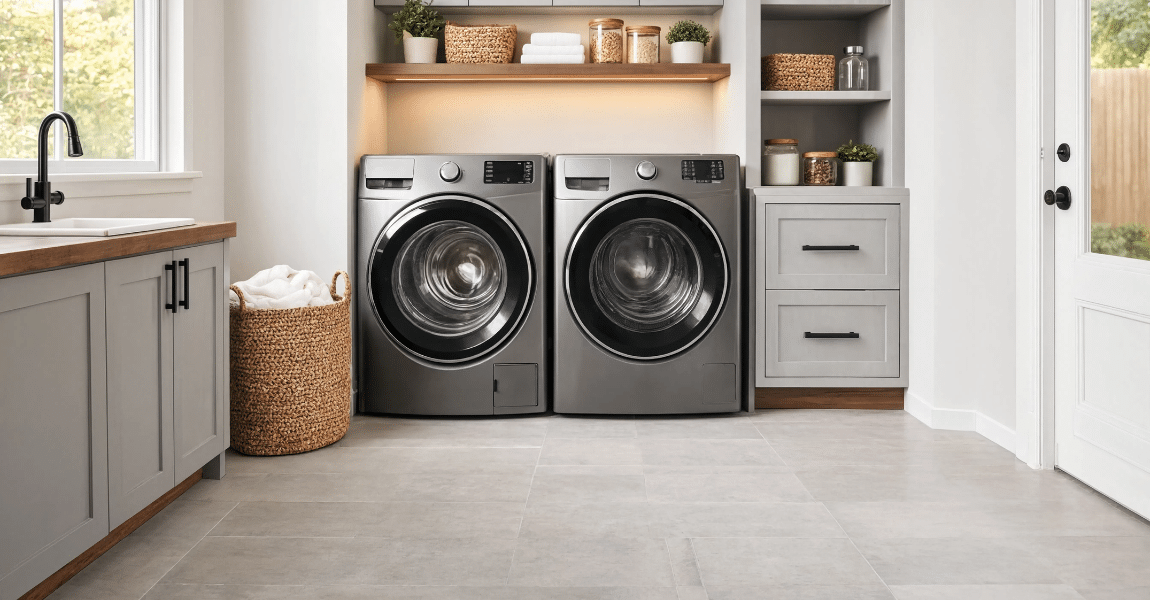
The best laundry room flooring is porcelain tile or rigid-core waterproof vinyl (LVP/SPC). Both are fully waterproof, handle the weight of a washer and dryer, and clean easily. Vinyl sheet is the budget seamless option; tile is the most durable. The one rule that overrides everything: in a laundry room, choose 100% waterproof — not “water-resistant.”
I tell every client the same thing about laundry rooms: assume the washer will leak someday, because eventually one does. A supply hose lets go, a drain backs up, or the machine overflows, and suddenly there’s water on the floor for hours before anyone notices. The flooring that survives that is the flooring you want. Anything less and you’re not just replacing the floor — you’re drying out the subfloor underneath it.
What makes a floor right for a laundry room
- 100% waterproof — leaks and overflows are a when, not an if. Water resistance isn’t enough.
- Appliance-weight tolerance — a loaded washer is heavy and vibrates; the floor and seams must hold up.
- Leak and splash resistance — minimal seams, or sealed seams, so water can’t get underneath.
- Easy to clean — detergent spills, lint, the occasional muddy load.
Laundry room flooring compared at a glance
| Material | Waterproof? | Appliance-ready | Seams | Typical installed cost (per sq ft) |
|---|---|---|---|---|
| Porcelain / ceramic tile | Yes | Excellent | Grouted (seal it) | $7–$18 |
| Luxury vinyl plank (LVP/SPC) | Yes (rigid core) | Very good | Click seams | $4–$11 |
| Vinyl sheet | Yes | Good | Nearly seamless | $2–$6 |
| Rubber | Yes | Excellent | Sheet/tiles | $3–$8 |
The best options, ranked
1. Porcelain & ceramic tile — the most durable choice
Tile is the floor I trust most under appliances. It’s completely waterproof, it doesn’t flex or dent under a heavy, vibrating washer, and it can sit in standing water indefinitely without damage. Seal the grout (or use epoxy grout) and it’s essentially maintenance-free. The downsides — hard, cold, pricier install — barely matter in a utility room you don’t stand in for long.
Pros: fully waterproof, handles appliance weight, extremely durable, survives flooding.
Cons: grout needs sealing, harder install. See the tile flooring guide.
Best for: anyone wanting a permanent, worry-free laundry floor.
2. Rigid-core luxury vinyl (LVP/SPC) — waterproof and easy
Rigid-core waterproof vinyl is a superb laundry floor and easier/cheaper to install than tile. SPC (stone-plastic composite) in particular is dimensionally stable and handles appliance weight well. It’s warmer and quieter than tile, fully waterproof, and DIY-friendly. My one caution: install it well around the seams and use the manufacturer’s transitions so water can’t migrate under the edges.
Pros: waterproof, comfortable, affordable, DIY-friendly, fast install.
Cons: seams must be installed correctly; cheaper products can dent under appliance feet. See the vinyl flooring guide.
Best for: most laundry rooms; the best balance of cost, comfort, and protection.
3. Vinyl sheet — the seamless budget pick
Sheet vinyl shines in a laundry room because it’s essentially seamless — one continuous sheet means almost nowhere for water to get underneath. It’s the cheapest fully-waterproof option and easy to clean. It looks more utilitarian than tile or plank, but in a hidden laundry closet, who’s judging? Great value where function beats looks.
Pros: seamless waterproofing, cheapest option, easy clean.
Cons: lower-end appearance, can be punctured or torn, replace rather than patch.
Best for: laundry closets, rentals, budget renovations.
4. Rubber — durable and forgiving
Rubber flooring is tough, fully waterproof, and surprisingly practical in a laundry room — it holds up to detergent, water, and heavy machines, dampens vibration and noise, and is comfortable to stand on. It reads more “mudroom/gym” than “polished laundry,” but for a hardworking utility space, it’s an excellent, underused choice.
Pros: waterproof, durable, anti-vibration, comfortable, slip-resistant.
Cons: utilitarian look, limited styles. See the rubber flooring guide.
Best for: garage-adjacent or heavy-use laundry/utility rooms.
What I tell people to avoid
- Hardwood and engineered wood — a leak will destroy them; wood and laundry rooms don’t mix.
- Laminate (even “water-resistant”) — swells at the seams under standing water. Not worth the risk here.
- Carpet — traps detergent, lint, and moisture; molds after a leak.
- Peel-and-stick vinyl tiles — the seams lift and water gets underneath within a couple of years.
What laundry room flooring actually costs
Rough 2026 ranges (materials + install): vinyl sheet $2–$6/sq ft, rubber $3–$8, LVP/SPC $4–$11, porcelain tile $7–$18. Laundry rooms are usually small (35–80 sq ft), so even premium tile often lands around $400–$900 installed. Don’t forget you may need to disconnect and move appliances and check the subfloor for past leak damage — budget for both.
Laundry room flooring ideas
- Patterned porcelain tile — a fun spot to use a bold encaustic-look tile since the room is small.
- Wood-look SPC plank to match adjoining mudroom or kitchen floors for a seamless flow.
- A floor drain + tile if you’re renovating to the studs — the ultimate leak insurance.
- Rubber roll for a basement laundry that doubles as a utility/workout space.
Frequently asked questions
What flooring is best for a laundry room?
Porcelain tile for maximum durability, or rigid-core (SPC) waterproof vinyl for the best balance of cost, comfort, and protection.
SPC vs WPC for a laundry room?
SPC (stone-plastic composite) is denser and more dimensionally stable under heavy, vibrating appliances, so it’s my pick for laundry rooms. WPC is softer and more comfortable but better suited to living spaces.
Is vinyl plank waterproof enough for a laundry room?
Rigid-core/SPC vinyl is fully waterproof and an excellent laundry floor when seams and transitions are installed properly. Avoid cheap “water-resistant” vinyl.
Can you tile under a washer and dryer?
Yes — tile is ideal under appliances because it’s waterproof and won’t dent or flex under the weight. Just ensure the subfloor is solid and the grout is sealed.
Related: best flooring for bathrooms · best flooring for mudrooms & entryways · best flooring for basements· best flooring for every room