
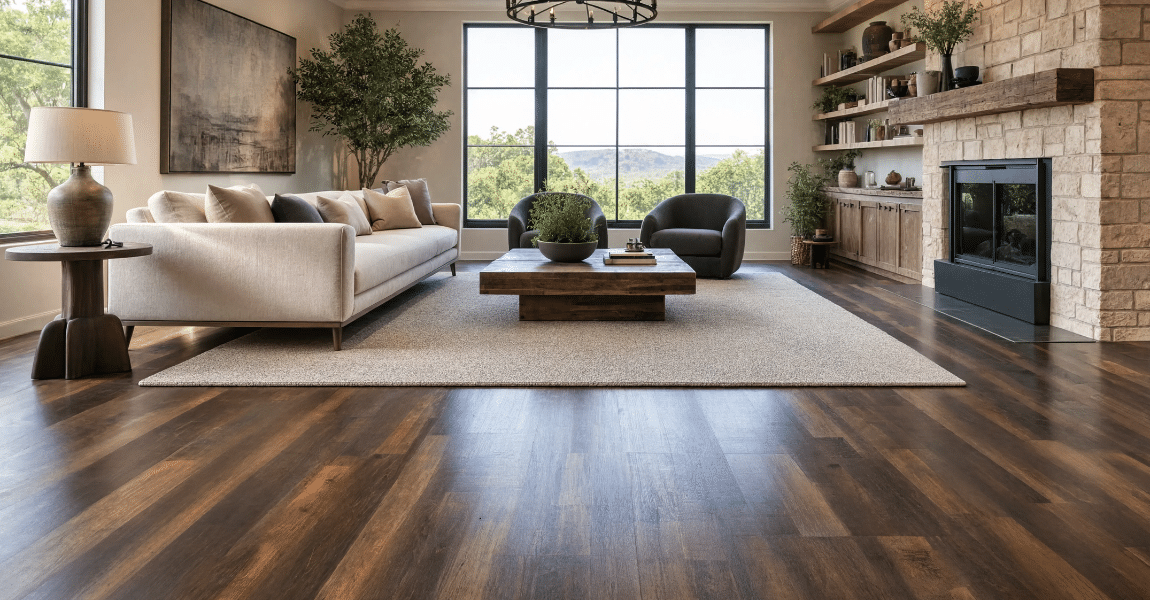
The best living room flooring is hardwood or engineered hardwood for warmth, style, and resale value, with luxury vinyl plank (LVP) as the durable, budget-friendly runner-up that handles family life. Tile suits warm climates, carpet adds cozy comfort, and laminate is the value pick. Unlike a kitchen or bath, you have real freedom here – so the choice comes down to lifestyle and budget more than survival against water.
The living room is the room people agonize over most, and I understand why – it’s the floor you see and use the most, and the one guests notice. The good news is that without the moisture constraints of a wet room, almost every material is on the table. After 25+ years of installs, here’s how I help people narrow it down.
What makes a floor right for a living room
- Durability for traffic. This is one of the highest-traffic rooms in the house; the floor needs to wear well for years.
- Warmth and comfort. You sit, walk barefoot, and kids play here. Cold, hard floors work but want rugs.
- Style and resale value. This is your home’s showpiece floor – looks and buyer appeal matter.
- Sunlight resistance. Living rooms usually have the largest windows in the house, and daily UV exposure fades some floors faster than others.
- Sound and acoustics. This is where the TV lives and where people gather – a floor that sounds hollow or echoes gets old fast.
- Easy maintenance. Living rooms collect dust, spills, and foot traffic; easy cleaning keeps them looking good.
Living room flooring compared at a glance
| Material | Durability | Comfort/ warmth | Resale appeal | Typical installed cost (per sq ft) |
|---|---|---|---|---|
| Hardwood | High | Warm | Highest | $6–$15 |
| Engineered hardwood | High | Warm | High | $6–$14 |
| Luxury vinyl (LVP/LVT) | High | Medium–warm | Medium | $4–$12 |
| Tile | Very high | Cool/hard | Medium | $7–$20 |
| Laminate | High (scratch) | Medium | Low–medium | $3–$8 |
| Carpet | Medium | Warmest | Low–medium | $3–$8 |
| Cork | Medium | Warm, cushioned | Low–medium | $5–$12 |
| Bamboo (strand-woven) | High | Warm | Medium | $5–$10 |
The best options, ranked
1. Hardwood & engineered hardwood – the classic showpiece
Real wood is still the floor that makes a living room feel finished, and it’s the strongest resale play – the National Association of Realtors’ Remodeling Impact Report consistently ranks new wood flooring and hardwood refinishing among the highest-ROI interior projects, with cost recovery at or above 100% at resale. Solid hardwood can be refinished several times over decades – a refinish runs about $3–$8 per square foot, far less than replacement. Engineered hardwood gives you the same look with more stability, which matters over concrete slabs or in homes with humidity swings; choose a veneer of 2mm or thicker if you want the option to refinish it once down the road.
For a high-traffic living room, species matters as much as format. On the Janka hardness scale, red oak (~1,290) is the durable default, hickory (~1,820) takes the most abuse, and softer species like American walnut (~1,010) show dents sooner. Whatever you choose, acclimating the hardwood before installation is non-negotiable – skipping it is the #1 cause of gapping I see in living rooms.
Pros: timeless, warm, highest resale value, refinishable (solid).
Cons: scratches/dents (heavy furniture is the main culprit – see our guide to protecting floors from furniture scratches), higher cost, sensitive to big spills. See the hardwood flooring guide.
Best for: long-term homeowners and anyone prioritizing resale and a premium feel.
2. Luxury vinyl plank (LVP) – durable family-proof value
LVP is what I recommend for busy households that want the wood look without the worry. It’s waterproof, scratch- and dent-resistant, comfortable, and far cheaper than real wood. Kids, pets, spills – it shrugs them off.
Two specs matter when you’re buying. First, the wear layer: 12 mil is fine for a normal household, but go 20 mil for heavy traffic, big dogs, or rental properties. Second, the core: WPC (wood-polymer core) planks are thicker, softer, and warmer underfoot – my pick for living rooms – while SPC (stone-polymer core) is denser and more dent-resistant but firmer to stand on. If pets are the deciding factor, our pet-proofing your floors guide covers the details.
LVP won’t add as much resale value as hardwood and a flooring person can tell it isn’t wood up close, but for everyday living it’s hard to beat.
Pros: durable, waterproof, kid/pet-proof, affordable, low maintenance.
Cons: less resale value than wood, not “real.” See the vinyl flooring guide.
Best for: families, pet owners, rentals, and budget-conscious renovations.
3. Tile – durable and great in warm climates
Tile is bulletproof and stays cool, which is a feature in hot climates and a drawback in cold ones. It’s the most durable option and easy to clean, but it’s hard underfoot for a room where you relax, so it usually wants area rugs. In the right setting – a Southern or Southwestern home, an indoor-outdoor living space – it’s excellent.
Pros: extremely durable, cool in heat, easy clean, water-resistant.
Cons: hard and cold, less cozy, higher install cost. See the tile flooring guide.
Best for: warm climates, indoor-outdoor living, high-durability needs.
4. Laminate – the budget wood look
Modern laminate offers a convincing wood look with a very scratch-resistant surface for the lowest cost of the hard-surface options. Look for an AC3 rating at minimum for a living room – AC4 if your living room doubles as the main thoroughfare of the house. It can’t be refinished and adds little resale value, and cheap installs sound hollow underfoot – though the right underlayment fixes most of that. For a living room on a budget it performs well and installs fast.
Pros: affordable, scratch-resistant, easy click install, wood look.
Cons: no refinishing, lower resale value, can sound hollow underfoot. See the laminate flooring guide.
Best for: tight budgets and quick refreshes.
5. Carpet – the cozy, quiet choice
Carpet is the warmest, softest, quietest option, and for a media room or a family that wants a cozy space to sprawl, it’s still a great choice. Fiber matters: nylon is the durability king for high-traffic living rooms, triexta is the best stain resistance for kids and pets, and polyester is the budget pick for lower-traffic spaces. A low-to-medium pile hides traffic patterns better than plush. Carpet traps allergens and shows stains, and it’s fallen out of fashion for main living rooms, but for comfort and sound absorption nothing beats it.
Pros: warmest and softest, quiet, inexpensive, great for media rooms.
Cons: stains, traps allergens, dated for main living spaces. See the carpet flooring guide.
Best for: media rooms, cozy dens, cold climates.
6. Cork & bamboo – the eco-friendly picks
If sustainability is a priority, two options deserve a look. Cork is naturally warm, quiet, and slightly cushioned – genuinely comfortable to stand and play on – and it’s a renewable material harvested without cutting down the tree. It dents under heavy furniture and fades in direct sun, so it suits lower-traffic, shadier living rooms.
Bamboo – especially strand-woven bamboo, which is harder than most hardwoods – gives you a wood look from a fast-growing renewable resource at a lower price than oak. See the full cork flooring guide and bamboo flooring guide.
Best for: eco-conscious homeowners, quiet comfort (cork), wood look on a budget (bamboo).
Flooring for open-concept living rooms
If your living room flows into the kitchen or dining area, run one continuous floor through the whole space – transitions chop up an open plan and make both rooms feel smaller. That single decision changes the answer: the floor now has to survive the kitchen, not just the living room. Wood-look LVP is the easiest call because it’s waterproof end to end. Engineered hardwood works if you accept some risk at the sink and use mats. Tile throughout suits warm climates. Whatever you choose, order all the flooring from one lot at the same time – dye lots vary, and a mid-room lot change is visible forever.
Sunlight and fading: the living room problem nobody mentions
Living rooms take more direct UV than any other room, and floors fade unevenly – you notice it the day you move a rug or a sofa. Solid hardwood (especially exotic species like Brazilian cherry) changes color noticeably in the first year. Luxury vinyl and laminate hold color far better thanks to UV-resistant wear layers. Cork fades fastest. If you’re set on hardwood in a sun-drenched room: choose a lighter, UV-stable species like white oak, rotate rugs every few months for the first year so the floor ages evenly, and consider low-E window film or UV-filtering curtains for the biggest windows.
Sound and acoustics
Hard floors are the main reason modern living rooms echo. If you’ve traded carpet for hardwood or LVP and the TV suddenly sounds harsh, the floor is why. Three fixes: a quality underlayment with a decent IIC (Impact Insulation Class) rating — aim for IIC 50+ if there’s a room below; a large area rug covering the main seating zone; and softer wall furnishings. Among hard surfaces, cork is the quietest, WPC vinyl is next, and tile is the loudest. Laminate’s hollow footfall sound is almost always an underlayment problem, not a laminate problem.
Can you use radiant floor heating in a living room?
Yes — and the living room is one of the best rooms for it. Tile and stone conduct heat best and are the classic pairing. Engineered hardwood and most LVP are rated for radiant heat up to about 80–85°F surface temperature (check the manufacturer’s spec). Solid hardwood is riskier because heat cycling causes movement, and thick carpet with pad insulates the heat away from the room. If cold floors are the only thing pushing you toward carpet, radiant heat under tile or engineered wood is the better long-term answer.
What about avoiding anything?
Unlike wet rooms, the living room has no hard “never use this” list – every material works. The only real mistakes are gloss finishes that show every footprint, very dark floors that show dust and pet hair, and choosing a delicate floor for a house full of kids and dogs. Match the floor to how you actually live.
What living room flooring actually costs
Rough 2026 ranges (materials + install): carpet and laminate $3–$8/sq ft, LVP $4–$12, engineered hardwood $6–$14, solid hardwood $6–$15, tile $7–$20. The living room is usually one of the larger rooms, so material choice has a big impact on the total – a 300 sq ft living room ranges from about $900 in laminate to $4,500+ in premium hardwood or tile.
Living room flooring ideas
- Wide-plank engineered oak in a light, natural tone – the current go-to for a warm, modern look.
- Wood-look LVP carried from the kitchen into the living room for a seamless open-plan flow.
- Large-format tile with big area rugs to define seating zones in a warm-climate home.
- Low-pile or patterned carpet in a media room for sound and coziness.
Frequently asked questions
What is the most popular living room flooring?
Hardwood and wood-look luxury vinyl plank are the two most popular choices – hardwood for resale and warmth, LVP for durability and value.
Hardwood or vinyl for a living room?
Hardwood adds more resale value and a premium feel; LVP is more durable, waterproof, kid/pet-proof, and cheaper. Choose hardwood for a long-term home you’ll keep nice; LVP for a busy household.
What flooring adds the most home value?
Real hardwood consistently adds the most resale value in living spaces – buyers seek it out.
Best flooring for a high-traffic living room?
Luxury vinyl plank or tile for maximum durability, or a hard, durable engineered hardwood if you want real wood that can take a beating.
Is LVP good for a living room?
Yes – LVP is one of the two most popular living room floors. Choose a 12–20 mil wear layer and a WPC core for the warmest, most comfortable feel underfoot. Its only real trade-off is lower resale value than hardwood.
Should living room flooring match the kitchen?
In an open-concept home, yes – one continuous floor makes both spaces feel larger and is what buyers expect. In homes where the rooms are fully separate, matching is optional, but keep tones in the same family.
What color flooring is best for a living room?
Light-to-medium natural wood tones are the safest choice – they hide dust and pet hair, make the room feel bigger, and have the broadest buyer appeal. Very dark floors show every speck of dust; very gray tones are already dating.
Is carpet outdated in living rooms?
For main living rooms, mostly yes – hard surfaces with area rugs are what buyers expect now. But carpet remains the best choice for dedicated media rooms, basements, and cold-climate dens where warmth and sound absorption matter most.
Related: best flooring for bedrooms· best flooring for kitchens· best flooring for every room· hardwood flooring guide