
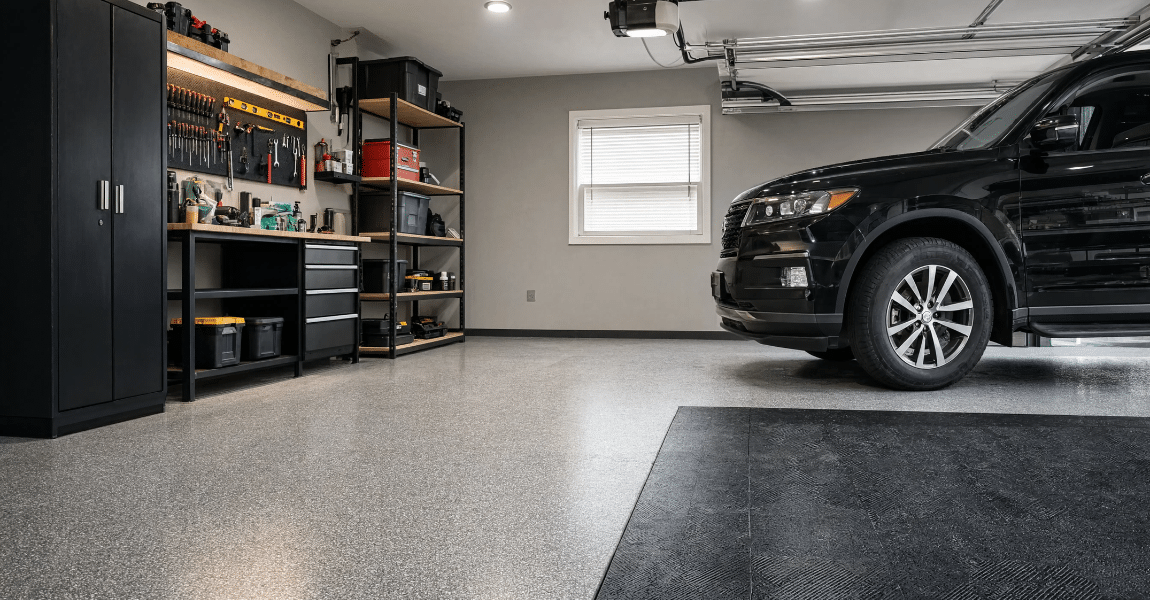
The best garage flooring is a polyaspartic or epoxy coating for a durable, sealed, showroom finish, or polished concrete if you want low-cost and low-fuss. Interlocking or rubber tiles are the best no-prep, DIY-friendly option. A garage floor lives in a different world from the rest of your house — it has to survive vehicle weight, hot tires, oil, and chemicals — so forget wood, vinyl, and tile-as-you-know-it here.
The garage is the one room where “flooring” usually means a concrete slab and a decision about what to put on it. After 25+ years around floors, I’ll tell you the most common garage mistake is treating it like an indoor room — people put down the wrong coating over an unprepared slab and watch it peel within a year. The slab and its prep matter more than almost anything else. Here’s how to get a garage floor that lasts.
What makes a floor right for a garage
- Hot-tire pickup resistance. Hot tires can lift cheap coatings right off the slab. This is the #1 failure I see, and modern EVs with high torque make it worse.
- Chemical and oil resistance. Oil, gas, brake fluid, road salt, and de-icers all attack a garage floor. It needs to shrug them off and wipe clean.
- Impact and weight tolerance. Dropped tools, jack stands, and the weight of a vehicle demand a tough surface.
- Slab prep. Coatings only last if the concrete is clean, profiled (etched or ground), and dry. This step makes or breaks the result.
Garage flooring compared at a glance
| Option | Durability | Hot-tire resistance | DIY-friendly | Typical installed cost (per sq ft) |
|---|---|---|---|---|
| Polyaspartic coating | Excellent | Excellent | Pro recommended | $5–$12 |
| Epoxy coating | Very high | Good (quality systems) | DIY kits exist | $3–$10 |
| Polished concrete | High | Excellent | No (specialist) | $3–$8 |
| Interlocking tiles | High | N/A (tiles, not coating) | Very (snap together) | $3–$8 |
| Rubber rolls/tiles | High | N/A | Very | $3–$8 |
The best options, ranked
1. Polyaspartic coating — the premium, longest-lasting finish
Polyaspartic is the coating I recommend most for a garage you care about. It’s tougher than epoxy, resists hot-tire pickup and chemicals better, cures fast (often a one-day install), and won’t yellow in sunlight. It’s the closest thing to a permanent, showroom-quality garage floor. The catch: it’s more expensive and cures so quickly that it’s really a job for pros, not a weekend DIY.
Pros: maximum durability, best hot-tire and chemical resistance, fast cure, UV-stable.
Cons: higher cost, fast cure makes DIY hard. See the epoxy flooring guide for the coating family.
Best for: homeowners who want a permanent, high-performance garage floor and will hire it out.
2. Epoxy coating — the proven workhorse
Epoxy has been the garage-floor benchmark for decades for good reason: it’s durable, chemical- and abrasion-resistant, and creates a hard, sealed, easy-clean surface. DIY kits exist and can look great, but the result lives and dies by slab prep — the surface must be properly etched or ground and bone-dry, or it will peel. Quality professional epoxy systems resist hot tires well; cheap single-coat kits don’t.
Pros: durable, chemical-resistant, sealed and easy to clean, DIY kits available.
Cons: demands thorough slab prep, cheaper kits risk hot-tire peeling, can yellow in UV.
Best for: a tough, attractive sealed floor, with prep done right.
3. Polished concrete — low-cost, nearly indestructible
If you already have a sound slab, polishing and sealing it is the most cost-effective garage floor there is. It’s extremely durable, doesn’t peel (there’s no coating to lift), resists hot tires inherently, and is easy to clean. It’s plainer-looking and shows stains if not sealed well, but for pure practicality it’s hard to beat.
Pros: very durable, no peeling, hot-tire-proof, low cost if the slab exists.
Cons: plainer look, needs sealing, requires a specialist to polish.
Best for: budget-minded homeowners with a good existing slab.
4. Interlocking tiles — the no-prep, instant DIY option
Snap-together polypropylene or PVC tiles are the easiest garage floor to install — no slab prep, no curing, just lay them down over the concrete, even if the slab is cracked or stained. They handle vehicle weight, come in colors/patterns, and can be lifted and replaced. They’re not a sealed surface, so liquids can get between tiles to the slab, but for a fast, flexible, renter-friendly solution they’re excellent.
Pros: no prep, instant DIY install, hides a bad slab, removable, durable.
Cons: liquids can seep between tiles, less seamless look.
Best for: quick makeovers, cracked/stained slabs, renters, DIYers.
5. Rubber rolls and tiles — durable and forgiving
Rubber flooring is tough, impact-absorbing, and great if your garage doubles as a workshop or gym area. It protects the slab, dampens noise, and is comfortable to stand on. It’s not for the area where a car’s hot tires park, but for work zones and multi-use garages it’s a practical, durable choice.
Pros: durable, impact-absorbing, comfortable, protects the slab.
Cons: not ideal under parked vehicles, utilitarian look. See the rubber flooring guide.
Best for: workshop zones and garage gyms (see best flooring for home gyms).
What I tell people to avoid
- Wood, laminate, and standard vinyl — none survive vehicle weight, hot tires, or chemicals. They have no place in a garage.
- Cheap single-coat epoxy kits over an unprepared slab — the classic peel-in-a-year mistake. Prep is everything.
- Coating a damp slab — moisture from below will push any coating off. Moisture-test first.
- Skipping the concrete profile — etching or grinding is what lets a coating actually bond.
What garage flooring actually costs
Rough 2026 ranges (materials + install): polished concrete and tiles $3–$8/sq ft, epoxy $3–$10, polyaspartic $5–$12. DIY epoxy kits and snap-together tiles are the cheapest paths; professional polyaspartic is the priciest but longest-lasting. For a two-car garage (~400 sq ft), expect roughly $1,200 (DIY) to $5,000 (pro polyaspartic). Always budget for slab prep — grinding and crack repair are where coating jobs succeed or fail.
Garage flooring ideas
- Polyaspartic with a decorative flake (chip) finish — the popular showroom look that also hides minor imperfections.
- Polished concrete with a clear sealer for a clean, modern, budget-friendly finish.
- Interlocking tiles in a two-tone checkerboard for a fast, no-prep custom look.
- Rubber in a workshop/gym corner, coating under the car — zone the garage by use.
Frequently asked questions
What is the best garage floor coating?
Polyaspartic is the top-performing coating — tougher than epoxy, more resistant to hot tires and chemicals, UV-stable, and fast-curing. Epoxy is the proven, more budget-friendly alternative.
Epoxy vs polyaspartic for garages?
Polyaspartic is more durable, more hot-tire- and UV-resistant, and cures faster, but costs more and is best installed by pros. Epoxy is cheaper and DIY-friendly but more prone to yellowing and, in cheap kits, peeling. Many premium systems use an epoxy base with a polyaspartic topcoat.
Do garage floor tiles hold up to cars?
Yes — quality interlocking polypropylene/PVC tiles are engineered for vehicle weight. Their advantage is no slab prep; their downside is that liquids can seep between tiles to the concrete below.
Is polished concrete good for a garage?
Very — it’s durable, hot-tire-proof (no coating to lift), low-cost if you already have a sound slab, and easy to clean. It’s plainer-looking and needs sealing, but it’s one of the most practical options.
Related: best flooring for home gyms· best flooring for basements· best flooring for every room