
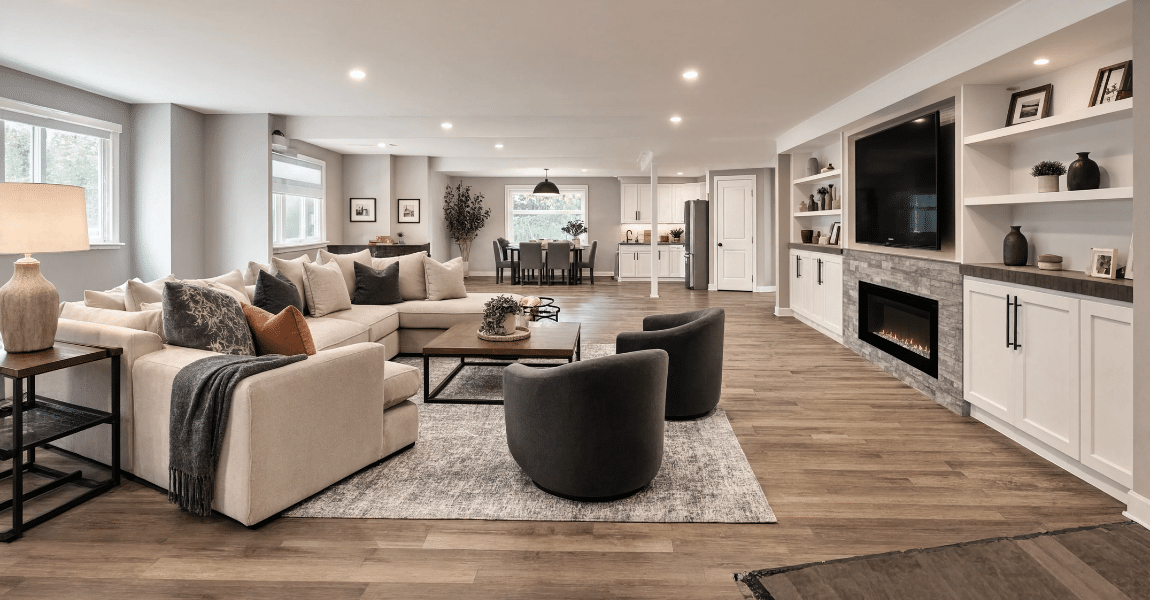
The best basement flooring is waterproof luxury vinyl (rigid-core LVP) for most finished basements, or porcelain tile / epoxy if you want maximum moisture immunity. The golden rule below grade: choose a waterproof, inorganic material and deal with the concrete slab’s moisture before you install anything.
Basements are different from every other room because the threat comes from below and around — moisture wicks up through the concrete slab and in through foundation walls, even when the floor looks bone dry. I’ve torn out more ruined basement floors than I can count, and nearly every one failed for the same reason: the homeowner treated the basement like an upstairs room. Don’t. Here’s how to get it right.
What makes a floor right for a basement
- Waterproof and moisture-proof — it must tolerate slab moisture and the risk of minor flooding.
- Mold/mildew resistance — organic materials (real wood, standard carpet pad) feed mold in damp, low-airflow basements.
- Below-grade suitability — the product must be rated for below-grade use; not all are.
- Slab prep first — moisture-test the concrete, address any vapor issues, and level the slab. This step is non-negotiable.
Before you buy anything: do a moisture test on the slab (tape a plastic sheet down for 24–48 hours and check for condensation). If the slab is damp, fix drainage and consider a vapor barrier or dimpled subfloor membrane first. See our subfloor moisture testing guide.
Basement flooring compared at a glance
| Material | Moisture immunity | Comfort/warmth | Notes | Typical installed cost (per sq ft) |
|---|---|---|---|---|
| Luxury vinyl (rigid-core LVP) | Excellent | Medium | Best all-rounder below grade | $4–$10 |
| Porcelain / ceramic tile | Excellent | Cold/hard | Near-bulletproof, can flood and survive | $7–$18 |
| Epoxy / polyaspartic coating | Excellent | Hard | Seamless, great for utility/gym areas | $3–$12 |
| Engineered wood | Moderate | Warm | Only with a proper subfloor + dry slab | $6–$14 |
| Carpet tile | Low–moderate | Warmest | Modular; replace tiles if they get wet | $3–$8 |
The best options, ranked
1. Waterproof luxury vinyl plank (rigid-core/SPC) — the basement workhorse
For a finished, livable basement, rigid-core LVP is what I recommend most. It’s 100% waterproof, it can be installed as a floating floor directly over a prepared slab (often with an attached pad), and if the basement ever takes on a little water, it survives where wood and laminate would be destroyed. It’s warmer and quieter than tile, and the wood/stone looks are convincing.
Pros: waterproof, below-grade rated, comfortable, floats over concrete, survives minor flooding.
Cons: still hard if you skip an underlayment; quality varies. See the vinyl flooring guide.
Best for: finished basements, rec rooms, basement bedrooms and offices.
2. Porcelain & ceramic tile — flood-proof and forever
Tile doesn’t care about moisture at all. If your basement has any history of water, tile is the safest choice — it can literally be flooded, dried, and reused. The downsides are the usual ones: it’s cold and hard (a real consideration in a basement), and installation over a slab is labor-intensive. Radiant heat underneath solves the cold problem beautifully.
Pros: total moisture immunity, extremely durable, radiant-heat friendly.
Cons: cold, hard, higher install cost. See the tile flooring guide.
Best for: basements with moisture history, walk-outs, or future-proofing.
3. Epoxy or polyaspartic coating — seamless and tough
If your basement is more utility than living room — a gym, workshop, laundry, or storage area — a coating applied directly to the slab is excellent. It’s seamless (no seams for water to get under), incredibly durable, and easy to clean. It’s hard and industrial-looking, so it’s not for a cozy family room, but for hard-use zones it’s ideal.
Pros: seamless, very durable, moisture-proof, easy clean.
Cons: hard/cold, industrial look, slab must be properly prepped. See the epoxy flooring guide.
Best for: basement gyms, workshops, utility areas.
4. Engineered wood — only if the basement is dry
Engineered hardwood can work in a basement, but only a genuinely dry one, and only over a proper subfloor with a vapor barrier. It brings warmth and a high-end look. I’m cautious recommending it below grade — the risk/reward usually favors LVP that looks like wood instead.
Pros: warm, real-wood look, premium feel.
Cons: moisture-sensitive, demands a dry slab + subfloor, riskier below grade. See the hardwood flooring guide.
5. Carpet tile — the warmest, with caveats
Modular carpet tiles are the coziest basement option and clever for one reason: if a section gets wet, you replace those tiles instead of the whole floor. Use a synthetic, low-pile, moisture-resistant product with a waterproof backing — never standard broadloom carpet with a foam pad, which traps moisture and molds.
Pros: warm, soft, modular (replace wet sections), inexpensive.
Cons: lower moisture tolerance, must choose synthetic/waterproof-backed. See the carpet flooring guide.
What I tell people to avoid
- Solid hardwood — it will cup and rot from slab moisture. Never below grade.
- Standard laminate — swells at the seams the moment it meets slab moisture or a leak.
- Broadloom carpet over foam pad — a mold factory in a damp basement.
- Skipping the moisture test — the single most expensive mistake in basement flooring.
What basement flooring actually costs
Rough 2026 ranges (materials + install): carpet tile $3–$8/sq ft, epoxy coating $3–$12, LVP $4–$10, tile $7–$18, engineered wood $6–$14. Budget separately for slab prep: self-leveling compound, a vapor barrier, or a dimpled subfloor membrane can add $1–$4/sq ft but will save your floor. For a 600 sq ft basement, expect roughly $2,500–$7,000 all-in depending on material and prep.
Basement flooring ideas
- Wood-look rigid LVP over a dimpled membrane subfloor — warm, dry, and forgiving.
- Large-format porcelain with radiant heat for a basement that never feels like a basement.
- Epoxy with a flake finish for a clean, modern gym or workshop.
- Carpet tiles in a play area with LVP everywhere else — zone the space by use.
Frequently asked questions
What is the best waterproof basement flooring?
Rigid-core (SPC) luxury vinyl for living spaces; porcelain tile or an epoxy coating for maximum moisture immunity in utility areas.
Can you put flooring directly on a concrete basement slab?
Yes — LVP, tile, and coatings go right over a prepared slab. But “prepared” is the key word: moisture-test, level, and add a vapor barrier or membrane if needed first.
Is vinyl plank good for basements?
It’s the best all-round choice for most finished basements — waterproof, below-grade rated, and it survives minor flooding.
Do you need a subfloor in a basement?
Not always, but a dimpled subfloor membrane is cheap insurance: it creates an air gap that manages slab moisture and warms the floor. I recommend one in any basement with moisture history.
Related: best flooring for laundry rooms · best flooring for garages · best flooring for every room· subfloor moisture testing