
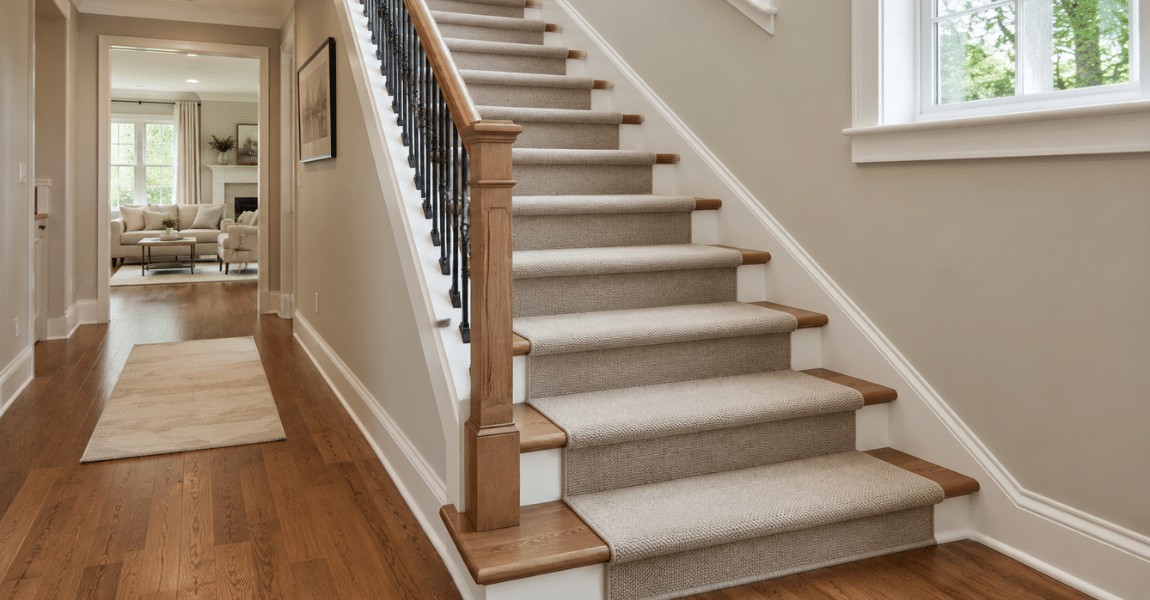
The best flooring for stairs is carpet if safety and quiet are your priorities (it gives the most grip and absorbs noise), or hardwood with a runner if you want looks plus safety. Luxury vinyl and laminate work too, but bare, slick stairs are a genuine fall risk — traction should drive your choice before style does.
Stairs are the one place where a flooring mistake isn’t just ugly, it’s dangerous. I’ve been called to too many homes where someone installed beautiful, glossy hardwood stairs and then realized they were slipping on them in socks. Stairs are high-traffic, high-consequence, and installed differently from a flat floor (treads and risers, not planks), so they deserve their own decision. Safety comes first here — then everything else.
What makes a floor right for stairs
- Safety and traction. This is non-negotiable. A slick stair surface is a fall hazard, especially for kids, older adults, and pets.
- Durability. Stairs are among the highest-traffic surfaces in any home and take concentrated wear on the edges.
- Noise. Hard stair surfaces are loud; soft ones are quiet from the constant up-and-down.
- Matching the adjoining floors. Stairs connect two levels — they should coordinate with the floors above and below.
- Proper treads and nosing. Stair installs need a safe, rounded nosing (the edge) and secure treads — an install detail, not just a material choice.
Stair flooring compared at a glance
| Material | Safety/traction | Durability | Noise | Typical installed cost (per step) |
|---|---|---|---|---|
| Carpet (full or runner) | Best | Medium | Quietest | $30–$80 |
| Hardwood (+ runner) | Good with a runner | High | Loud (runner helps) | $100–$200+ |
| Luxury vinyl (LVP/LVT) | Good (textured) | High | Medium | $60–$150 |
| Laminate | Fair | High | Loud | $50–$120 |
The best options, ranked
1. Carpet — the safest stair surface
Carpet is the safest flooring for stairs, full stop. It provides a natural grip so feet don’t slip, it cushions a fall, and it’s by far the quietest — it muffles the constant noise of people going up and down. It’s also the most forgiving to install on stairs. The downsides are wear (stair edges take a beating) and stains. For families with young kids, older adults, or pets, I almost always recommend carpet or at least a runner.
Pros: safest grip, cushions falls, quietest, most comfortable.
Cons: wears at the edges, stains, dated for some looks. See the carpet flooring guide.
Best for: families, homes with kids/elderly/pets, anyone prioritizing safety and quiet.
2. Hardwood with a runner — looks plus safety
Hardwood stairs are beautiful and durable, and they match hardwood floors above and below for a seamless look. The catch is that bare hardwood stairs are slippery — so I strongly recommend a runner (a carpet strip down the center) or non-slip treads. That combination gives you the best of both worlds: the look of wood with the grip of carpet where you step. Done right, it’s the most attractive stair option there is.
Pros: beautiful, durable, matches wood floors, and a runner adds safety.
Cons: slippery when bare, loud without a runner, and higher cost. See the hardwood flooring guide.
Best for: homes with hardwood floors; a classic, high-end look (always with a runner or treads).
3. Luxury vinyl (LVP/LVT) — durable and budget-smart
LVP stair treads are increasingly popular: waterproof, scratch-resistant, affordable, and able to match LVP floors elsewhere. Choose a textured finish for grip and use proper stair-nosing profiles. It’s more labor-intensive to install on stairs than on a flat floor, but it’s a durable, cost-effective choice — especially for basement stairs.
Pros: durable, waterproof, affordable, matches LVP floors, textured options for grip.
Cons: needs proper nosing; smooth finishes can be slick. See the vinyl flooring guide.
Best for: basement stairs, budget projects, homes with LVP floors.
4. Laminate — budget look-alike, with care
Laminate stair treads give a wood look at a lower price and are very scratch-resistant. But laminate can be slippery and loud on stairs, and the nosing pieces must be installed carefully for safety. It’s a workable budget option, but I’d choose textured LVP or a runner over bare laminate for traction.
Pros: affordable, scratch-resistant, wood look.
Cons: slippery and loud, nosing must be done right. See the laminate flooring guide.
Best for: budget projects where you’ll add traction.
What I tell people to avoid
- Bare, glossy hard surfaces — the most common dangerous mistake. Always add a runner or non-slip treads to wood or smooth laminate.
- Tile on stairs — hard, slippery, and unforgiving in a fall. Almost never the right call indoors.
- Skipping proper nosing — the rounded stair edge isn’t optional; it’s a safety and durability essential.
- Mismatched stairs — stairs that clash with the floors they connect look like an afterthought.
What stair flooring actually costs
Stairs are priced per step, not per square foot, because each tread and riser is cut and installed by hand — labor-intensive work. Rough 2026 ranges (materials + install): carpet $30–$80 per step, laminate $50–$120, LVP $60–$150, hardwood $100–$200+. A typical 13-step staircase, therefore, ranges from about $400 in carpet to $2,500+ in hardwood. Custom nosing, refinishing existing treads, or curved staircases increase costs.
Stair flooring ideas
- A patterned runner over wood stairs — the timeless look that adds grip and personality.
- Wood treads with painted white risers for a clean, classic contrast.
- Textured LVP on basement stairs to match a basement LVP floor durably and affordably.
- Full carpet on a back staircase where safety and quiet matter more than showpiece looks.
Frequently asked questions
What is the safest flooring for stairs?
Carpet — it provides the most grip, cushions falls, and is the quietest. If you prefer wood, add a runner or non-slip treads to make it safe.
Can you put vinyl plank on stairs?
Yes — LVP works well on stairs with proper stair-nosing profiles and a textured finish for grip. It’s durable, waterproof, and matches LVP floors, making it popular for basement stairs.
Carpet vs hardwood stairs?
Carpet is safer, quieter, cheaper, and softer; hardwood is more attractive and durable and matches wood floors. The best compromise is hardwood stairs with a carpet runner.
How much does it cost to redo stairs?
Stairs are priced per step: roughly $30–$80 (carpet) up to $100–$200+ (hardwood) per step, so a 13-step staircase runs about $400–$2,500+ depending on material and complexity.
Related: best flooring for living rooms· best flooring for bedrooms· best flooring for every room· flooring installation guides