
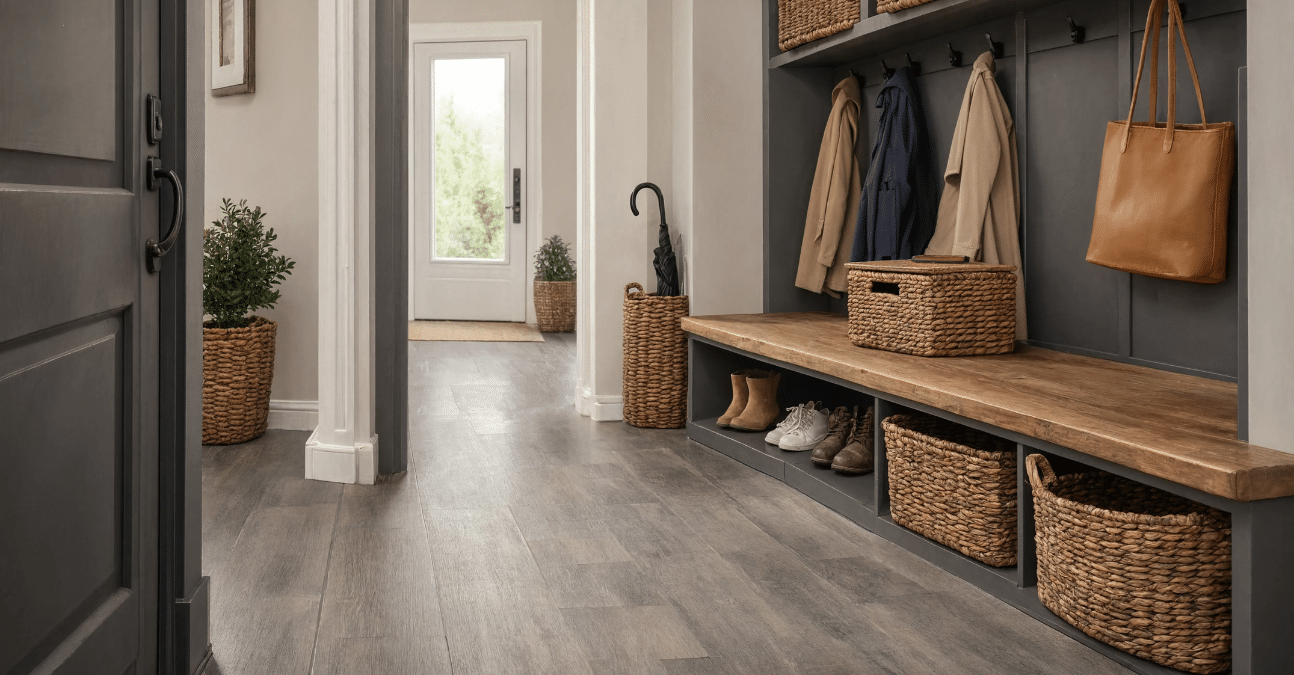
The best mudroom and entryway flooring is porcelain tile or rigid-core luxury vinyl plank — both handle wet boots, mud, grit, and heavy traffic while wiping clean in seconds. Sealed concrete and natural stone (like slate) are excellent for a more durable or upscale look. The job here is simple: pick something tough, moisture-proof, and easy to clean.
The mudroom and entryway take more daily abuse than any other floor in the house. This is where the outside world comes in — rain, snow, road salt, sand, mud, pet paws, dropped bags. In my experience the floors that fail here aren’t the ones that get wet; they’re the ones that can’t handle grit. Sand and salt are abrasive, so scratch and wear resistance matter as much as moisture resistance. Here’s what holds up.
What makes a floor right for a mudroom/entryway
- Durability against grit and traffic — sand, salt, and constant footfall wear down soft finishes fast.
- Moisture resistance — wet boots, dripping umbrellas, melting snow. It needs to shrug off water.
- Easy to clean — you’ll sweep and mop this floor constantly; texture that traps dirt is a chore.
- Slip resistance — water plus a hard floor at the entry is a fall risk.
- Bonus: radiant-heat friendly — a heated mudroom floor dries boots and feels great in winter.
Mudroom & entryway flooring compared at a glance
| Material | Durability | Moisture | Easy clean | Typical installed cost (per sq ft) |
|---|---|---|---|---|
| Porcelain / ceramic tile | Excellent | Excellent | Excellent | $7–$18 |
| Luxury vinyl plank (LVP) | High | Excellent | Excellent | $4–$11 |
| Sealed concrete | Excellent | Excellent (sealed) | Excellent | $3–$10 |
| Natural stone (slate) | Excellent | Good (sealed) | Good | $10–$25 |
The best options, ranked
1. Porcelain & ceramic tile — the mudroom champion
Tile is my top pick for mudrooms, and it’s not close. It’s waterproof, almost impossible to scratch or wear down (so grit and salt are no threat), and it cleans with a quick mop. Designers love it because porcelain can mimic stone, wood, or bold patterns. It pairs perfectly with radiant heat to dry wet boots and warm cold feet. Choose a textured or matte tile for grip, and you’ve got a floor that will look good for decades.
Pros: maximum durability, waterproof, scratch-proof, radiant-heat ready, endless styles.
Cons: hard, cold without heat, higher install cost, grout needs sealing. See the tile flooring guide.
Best for: snowy/rainy climates, busy families, anyone wanting a forever entry floor.
2. Luxury vinyl plank (LVP) — warm, tough, and seamless with the rest of the house
Rigid-core LVP is the most popular mudroom floor I install now, for good reason. It’s waterproof, scratch-resistant, comfortable underfoot, and — crucially — it lets you carry the same wood-look flooring straight from the entry into the living space for a seamless transition. It’s cheaper and warmer than tile and a manageable DIY.
Pros: waterproof, scratch-resistant, warm, affordable, flows into adjoining rooms.
Cons: very heavy grit can eventually scuff cheaper products; quality varies. See the vinyl flooring guide.
Best for: open entryways that connect to living areas; budget-conscious renovations.
3. Sealed concrete — practical and modern
If you have a slab (common in mudrooms off a garage), polished or sealed concrete is incredibly practical: waterproof when sealed, essentially indestructible, and it can be stained or tinted for an industrial-chic look. It’s hard and cold, but for a hardworking mudroom that’s often the point. Add a runner or mat where you stand.
Pros: waterproof (sealed), nearly indestructible, low-cost if the slab exists, modern look.
Cons: hard, cold, needs periodic resealing, can crack. See the concrete flooring guide.
Best for: garage-adjacent mudrooms, modern/industrial homes.
4. Natural stone (slate) — durable and handsome
Slate is a natural fit for entryways: it’s naturally slip-resistant (great when wet), extremely durable, and its irregular surface hides dirt between cleanings. It needs periodic sealing and costs more, but few floors say “solid, timeless entry” like real stone.
Pros: slip-resistant, very durable, hides dirt, upscale and timeless.
Cons: needs sealing, expensive, hard and cold, can be uneven.
Best for: higher-end homes, rustic or traditional entryways.
What I tell people to avoid
- Solid hardwood — wet boots and grit will scratch, stain, and cup it. Wrong room for it.
- Carpet — it becomes a filthy, soggy sponge in an entry. Use a washable rug over a hard floor instead.
- Standard laminate — grit scratches the surface and standing water swells the seams.
- Glossy tile — slippery when wet right where people walk in with wet shoes.
What mudroom & entryway flooring actually costs
Rough 2026 ranges (materials + install): sealed concrete $3–$10/sq ft (cheap if the slab already exists), LVP $4–$11, porcelain tile $7–$18, natural stone $10–$25. Mudrooms are typically small (30–80 sq ft), so even tile usually lands around $400–$1,000 installed. The extras to budget: a transition to the adjoining room’s floor, and possibly a built-in bench or boot tray area.
Mudroom & entryway flooring ideas
- Patterned encaustic-look porcelain — a small space is the perfect place for a bold tile moment.
- Wood-look LVP carried into the kitchen/living room for a seamless, larger-feeling main floor.
- Slate or stone-look tile with radiant heat to dry boots and warm winter mornings.
- A tiled “drop zone” inset within a wood-floor entry — durable where it’s wet, warm everywhere else.
Frequently asked questions
What is the most durable mudroom flooring?
Porcelain tile and sealed concrete are the most durable — both resist grit, moisture, and heavy traffic almost indefinitely.
Is tile or vinyl better for an entryway?
Tile is more durable and fully scratch-proof against grit; vinyl is warmer, cheaper, and flows seamlessly into adjoining rooms. For a hardworking snow-country mudroom, I lean tile; for an open entry that connects to living space, LVP.
What flooring hides dirt best?
Textured stone or stone-look porcelain, and mid-tone, patterned, or matte finishes — they disguise sand and footprints far better than dark, glossy, or solid-color floors.
What’s the best slip-resistant entryway flooring?
Slate or a textured/matte porcelain tile, which keeps grip even when wet from boots and umbrellas.
Related: best flooring for laundry rooms· best flooring for garages· best flooring for kitchens· best flooring for every room