
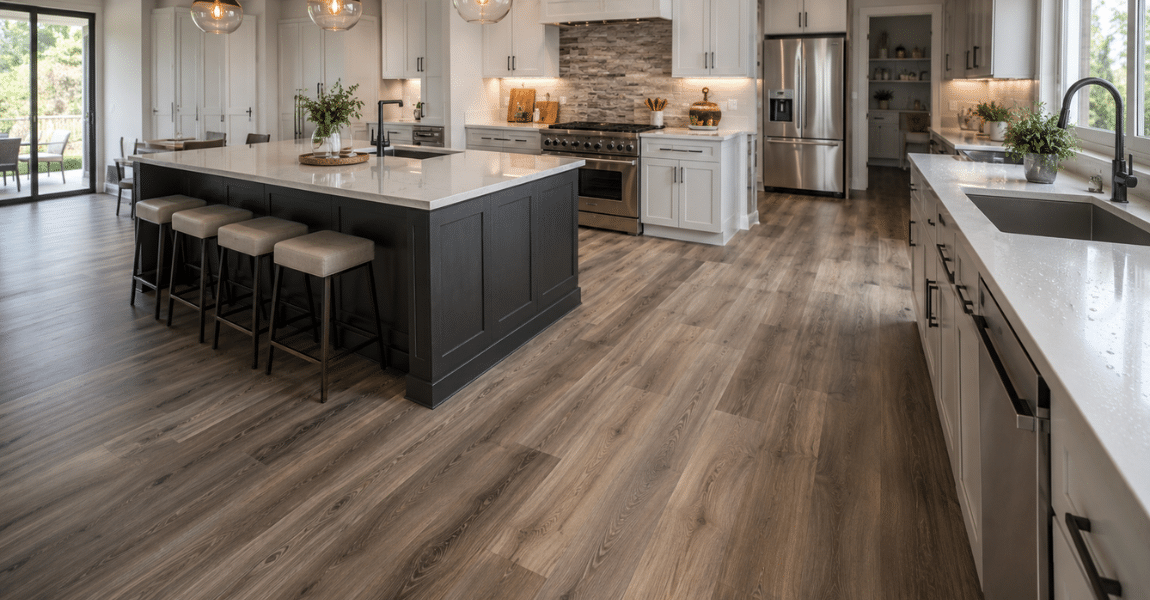
For most kitchens, luxury vinyl plank (LVP) or porcelain tile is the best flooring — both shrug off water, spills, and dropped pans, and they clean up in seconds. Choose LVP if you want warmth underfoot and a faster, cheaper install; choose porcelain tile if you want a floor that can outlast the house. Below, I’ll walk through every option the way I would for a client standing in their own kitchen.
I’ve spent more than 25 years installing floors, and the kitchen is where I see the most expensive mistakes. People fall in love with a look in a showroom and forget that a kitchen is, functionally, a wet room with knives, heat, and heavy traffic. So let’s start with what actually matters, then rank the materials.
What makes a floor right for a kitchen
Before any material, a kitchen floor has to clear four bars:
- Water resistance — dishwasher leaks, dropped glasses, mopping. Seams and edges matter as much as the surface.
- Stain & scratch resistance — tomato sauce, red wine, dog nails, a dropped cast-iron pan.
- Easy cleaning — you’ll wipe this floor constantly; texture that traps grime is a daily tax.
- Comfort underfoot — you stand here cooking. Rock-hard floors are tough on knees and backs.
No single material wins all four. Here’s how they stack up.
Kitchen flooring compared at a glance
| Material | Water resistance | Durability | Comfort | Typical installed cost (per sq ft) |
|---|---|---|---|---|
| Luxury vinyl (LVP/LVT) | Excellent (waterproof options) | High | Warm, soft | $4–$12 |
| Porcelain / ceramic tile | Excellent | Very high (50+ yrs) | Hard, cold | $7–$20 |
| Laminate | Fair–good (water-resistant lines only) | High (scratch) | Medium | $3–$8 |
| Engineered hardwood | Moderate | Medium–high | Warm | $6–$15 |
| Strand-woven bamboo | Moderate–good | High | Warm | $5–$11 |
The best options, ranked
1. Luxury vinyl plank (LVP/LVT) — my default recommendation
Modern luxury vinyl is the floor I put in most kitchens now, and it’s not close. The waterproof rigid-core (SPC) versions can sit in a puddle and not care, they’re warmer and quieter than tile, and a click-lock floating install goes down fast. It mimics wood or stone convincingly, and a damp mop is all the maintenance it needs.
Pros: waterproof options, comfortable, quiet, DIY-friendly, affordable, huge style range.
Cons: can dent under very heavy point loads (a dropped knife can nick cheaper products); not as premium-feeling or as resale-boosting as tile or real wood.
Best for: families, busy cooks, anyone who wants low fuss. See the full vinyl flooring guide.
2. Porcelain & ceramic tile — the forever floor
If you want a floor your grandkids could inherit, tile is it. Porcelain in particular is dense, water-resistant, and nearly indestructible. The trade-offs are real, though: it’s hard and cold underfoot (I always suggest a mat at the sink), grout needs sealing, and installation is labor-intensive — which is where the cost climbs. Drop a wine glass and it shatters; drop it on LVP and it might survive.
Pros: maximum durability and water resistance, timeless, great with radiant heat.
Cons: hard/cold, grout maintenance, higher install cost, unforgiving to dropped dishes.
Best for: long-term homes, warm climates, radiant-heat installs. More in the tile flooring guide.
3. Laminate — budget-friendly, with a caveat
Laminate gives you a convincing wood look and a tough, scratch-resistant surface for less money. The catch in a kitchen is water: standard laminate swells if water sits in the seams. Only buy a water-resistant or waterproof laminate line for a kitchen, and even then, wipe spills promptly.
Pros: affordable, very scratch-resistant, easy click install.
Cons: weak point is standing water at seams; can’t be refinished. See the laminate flooring guide.
Best for: tighter budgets where you’ll choose a water-resistant line and stay on top of spills.
4. Engineered hardwood — warmth with real wood
Engineered hardwood gives you a genuine wood surface over a stable plywood core, so it handles a kitchen’s humidity swings far better than solid wood. It’s beautiful and adds resale value, but it’s still wood — standing water and big spills are the enemy, and the wear layer only takes a refinish or two.
Pros: real-wood look, warm, adds home value, more stable than solid.
Cons: moderate water tolerance, dents/scratches, costs more. See the hardwood flooring guide.
Best for: open-plan kitchens that flow into living spaces where you want one continuous wood floor.
5. Strand-woven bamboo — the dark horse
Strand-woven bamboo is harder than most hardwoods and more water-tolerant than people expect, which makes it a credible, eco-friendly kitchen option. It’s still a wood-type product, so treat standing water the same way you would with hardwood.
Pros: very hard, sustainable, warm, distinctive look.
Cons: quality varies a lot by brand; moderate water tolerance. See the bamboo flooring guide.
What I tell people to avoid
- Solid hardwood — a kitchen’s moisture swings cause cupping and gaps. Engineered is the smarter wood choice here.
- Carpet — stains, traps food and odors, and holds moisture. It doesn’t belong in a kitchen.
- Cheap peel-and-stick vinyl tiles — they lift at the edges within a year or two near sinks and dishwashers.
What kitchen flooring actually costs
As a rough 2026 guide (materials + installation): laminate runs $3–$8/sq ft, LVP $4–$12, bamboo $5–$11, engineered hardwood $6–$15, and porcelain tile $7–$20 — tile’s labor is what pushes it up. For a typical 200 sq ft kitchen, that’s roughly $600 on the low end for laminate to $4,000 for a premium tile install. Get itemized quotes; “removal of old flooring” and “subfloor prep” are where surprise costs hide.
Kitchen flooring ideas that hold up
- Wood-look LVP in a wide plank for a warm, modern farmhouse feel without the water worry.
- Large-format porcelain (24″×24″+) to minimize grout lines and make a small kitchen feel bigger.
- Herringbone LVP or tile for a high-end look that hides crumbs surprisingly well.
- Matte, textured finishes over high-gloss — gloss shows every footprint and is slippery when wet.
Frequently asked questions
What flooring is most durable for a kitchen?
Porcelain tile, full stop — it routinely lasts 50+ years. For a durable floor that’s also comfortable and cheaper to install, rigid-core LVP is the practical winner.
Is vinyl or tile better for a kitchen?
Tile is more durable and adds more long-term value; vinyl is warmer, quieter, softer underfoot, and cheaper to install. I steer families and frequent cooks toward LVP, and long-term homeowners who want a forever floor toward porcelain tile.
What flooring do designers use in kitchens?
Increasingly large-format porcelain (often wood- or stone-look) and premium wide-plank LVP. Both photograph well and perform.
Is laminate good for kitchens?
Only water-resistant or waterproof laminate lines, and only if you wipe spills promptly. Standard laminate will swell at the seams.